Running costs
Jaguar E-Pace running costs: what UK ownership really costs
Jaguar E-Pace UK running costs: fuel or electric, insurance group, road tax, servicing and depreciation.
Updated 4th September 2026 DVSA data: Across 31,884 recorded MOT tests, 10.1% failed.
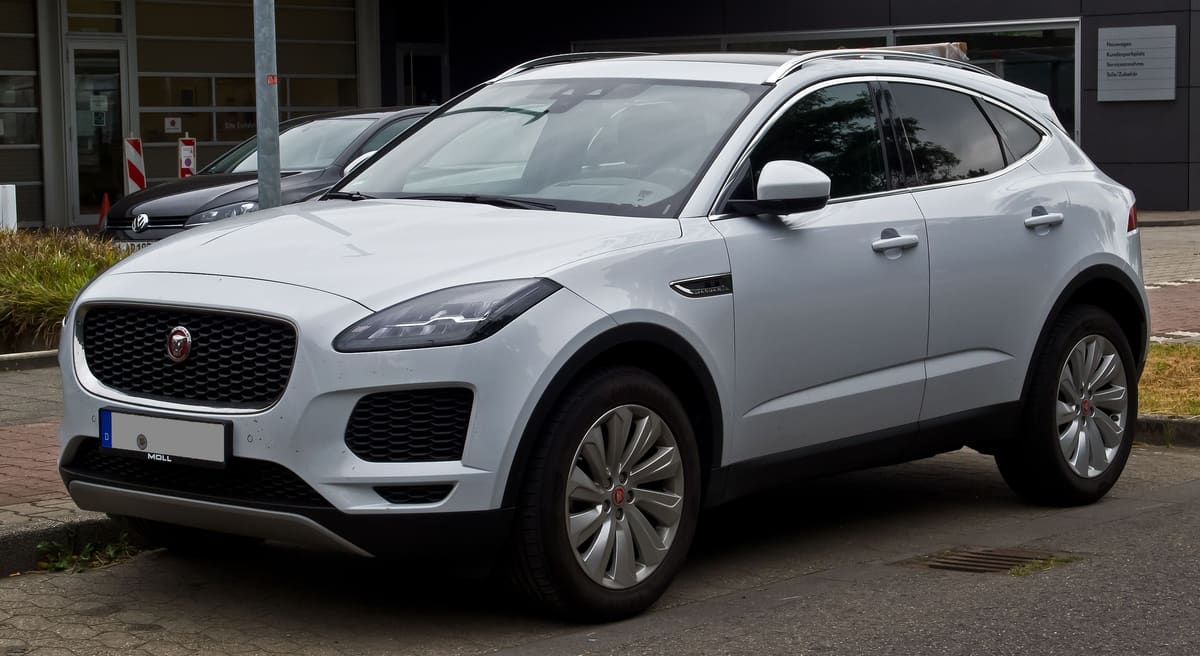
The Jaguar E-Pace offers a blend of luxury and performance, but ownership costs can vary significantly. Fuel costs depend on the engine choice, insurance groups range from 30 to 40, tax bands are typically D to H, servicing intervals are every 12 months or 16,000 miles, and depreciation can be around 50% after three years.
Fuel Costs
The fuel costs for the Jaguar E-Pace depend largely on the engine variant chosen. The petrol models generally offer lower fuel efficiency compared to the diesel options.
The choice between petrol and diesel will significantly impact your running costs, so consider your driving habits carefully.
Insurance Group
Insurance costs for the Jaguar E-Pace fall within groups 30 to 40, depending on the specific model and trim level. Higher performance variants, such as the P300, will typically sit at the upper end of this range, resulting in higher premiums.
It is advisable to obtain multiple quotes from different insurers to find the best deal. Factors such as your driving history, location, and the level of cover you choose will also influence your final insurance costs.
Tax Band
The E-Pace is available in various tax bands, primarily ranging from Band D to Band H. The exact band will depend on the engine size and CO2 emissions. For instance, the more efficient diesel engines may fall into lower tax bands, while higher-performance petrol variants could attract higher rates.
It’s essential to check the specific emissions figures for the model you are considering, as this will determine the exact tax liability.
Servicing Intervals
Jaguar recommends servicing the E-Pace every 12 months or every 16,000 miles, whichever comes first. This annual service includes essential checks and maintenance, such as oil changes, brake inspections, and tyre checks.
Regular servicing is crucial to maintaining the vehicle’s performance and resale value.
Typical Depreciation
Depreciation for the Jaguar E-Pace is relatively steep, with an average loss of around 50% of its value after three years. Factors such as mileage, condition, and market demand can influence this rate.
Luxury vehicles like the E-Pace tend to depreciate faster than more mainstream models, so it is wise to consider this when purchasing. Keeping the vehicle in good condition and maintaining a full service history can help mitigate some of the depreciation.
Overall Ownership Costs
When considering the overall ownership costs of the Jaguar E-Pace, it is essential to factor in fuel, insurance, tax, servicing, and depreciation. Total annual costs can vary widely based on individual circumstances and choices.
This figure can fluctuate based on driving habits, insurance choices, and how well the vehicle is maintained.
Jaguar E-Pace recall record
13 recalls have been issued for the Jaguar E-Pace, between 2018 and 2026.
E-PACE F-PACE Defender Discovery Sport Range Rover Evoque and Range Rover Velar PHEV Traction Battery Fire Risk
R/2025/555Issued 12 June 2026
Vehicles have experienced thermal overload which may manifest in smoke or fire that may occur underneath the rear of the vehicle where the high voltage traction battery is located. The root cause is not yet known and investigations are continuing. A vehicle thermal overload condition such as fire or smoke can result in increased risk of occupant injury and/or injury to persons outside the vehicle as well as property damage.
Remedy:Vehicles will be inspected by the retailer and as required at-risk battery packs will be replaced.
Affects cars built Nov 2020 to Mar 2022
Jaguar E-PACE Inappropriate Passenger Airbag Deployment
R/2025/260Issued 28 November 2025
On certain 2021 to 2024 Model Year Jaguar E-PACE vehicles during a passenger airbag deployment the airbag may tear as a result of improper folding of the airbag during the airbag assembly process.
Remedy:Affected Vehicles will have the passenger airbag module and associated components replaced.
Affects cars built May 2020 to May 2024
Electric Power Inverter Converter B (EPICB) Software Update
R/2025/281Issued 5 August 2025
On affected vehicles due to a software issue in the Electric Power Inverter Converter B (EPICB) it is possible that as the high voltage battery depletes during driving in EV mode the engine may not restart when the state of charge reduces and the vehicle will therefore lose power. There will not be an associated warning to the driver.
Remedy:Vehicle’s software to be updated in the Electric Power Inverter Converter B (EPICB) and other modules as required to ensure complete cross-module integration. In parallel an over-the-air update will be rolled out and customers who successfully complete this update will not need to visit a retailer.
Affects cars built Nov 2021 to Oct 2024
Jaguar E-PACE Inappropriate Passenger Airbag Deployment
R/2024/178Issued 20 August 2024
On affected vehicles during a passenger airbag deployment the airbag may tear as a result of the facia airbag deployment door panel not being sufficiently weakened.
Remedy:Vehicles will have the passenger airbag module and associated components replaced.
Affects cars built Oct 2020 to Oct 2022
9 older recalls not shown.
A recall applies to a build range, not to every car of this model. Check a registration to see whether one specific vehicle has an outstanding recall.
Jaguar E-Pace MOT record
From 31,884 recorded MOT tests, 10.1% failed.
| Registered | Tests | Failed | Median mileage |
|---|---|---|---|
| 2022 | 1,109 | 6.5% | 22,721 mi |
| 2021 | 3,535 | 7.7% | 31,183 mi |
| 2020 | 6,036 | 8.9% | 37,598 mi |
| 2019 | 11,040 | 10.9% | 45,882 mi |
| 2018 | 9,944 | 11.1% | 52,338 mi |
| 2017 | 220 | 10.9% | 50,882 mi |
Most common reasons for failure
- A tyre seriously damaged26.4%
- Tyre tread depth not in accordance with the requirements24.3%
- Brake disc or drum excessively weakened, insecure or fractured22.4%
- a brake lining or pad worn below 1.5mm18.5%
- Wiper blade missing or obviously not clearing the windscreen8.5%
Figures cover every Jaguar E-Pace tested in the DVSA dataset, not this specific car. Check a registration for the actual history of one vehicle.
Frequently asked questions
Are there any specific maintenance issues to watch for?
Drivers have reported issues with the E-Pace's infotainment system, particularly in earlier models. Keeping the software updated can help mitigate these problems. Additionally, check the condition of the brake pads, as they may need replacing every 20,000 to 30,000 miles.
How reliable is the Jaguar E-Pace?
The Jaguar E-Pace has received mixed reviews regarding reliability. While many owners appreciate its performance and comfort, some have reported electrical issues, particularly with the battery and starter motor, which may require attention after a few years of ownership.
Sources
- DVSA anonymised MOT tests and results (Open Government Licence v3.0)
- DVSA vehicle safety recalls (Open Government Licence v3.0)