Running costs
Jeep Cherokee running costs: what UK ownership really costs
Jeep Cherokee UK running costs: fuel or electric, insurance group, road tax, servicing and depreciation.
Updated 4th September 2026 DVSA data: Across 8,343 recorded MOT tests, 26.9% failed.
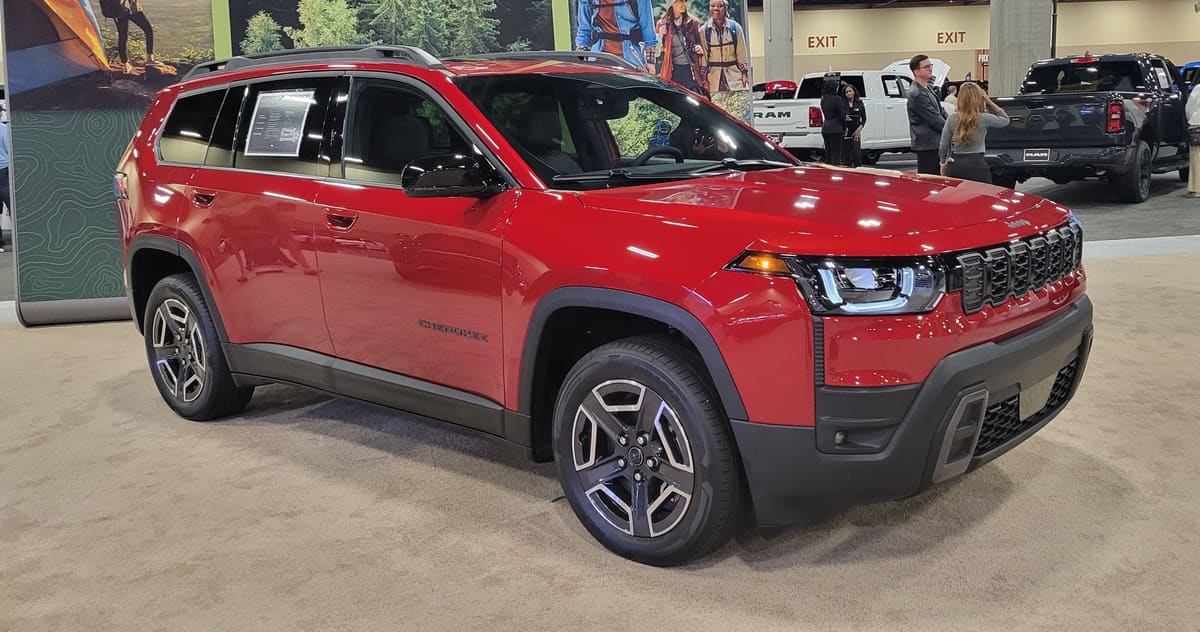
The running costs of a Jeep Cherokee can vary significantly depending on the model and engine type. Generally, owners can expect to pay for fuel, insurance, road tax, servicing, and depreciation.
Fuel Costs
Fuel costs for the Jeep Cherokee depend largely on the engine type and driving habits.
For those considering a diesel model, the higher fuel efficiency may justify the initial price difference. However, diesel models may incur additional costs related to AdBlue and potential DPF issues, which can affect long-term running costs.
Insurance Group
The insurance group for the Jeep Cherokee varies by model and trim level, generally falling between groups 24 and 30. This places it in the mid-range for insurance costs compared to other SUVs.
Choosing a model with advanced safety features may help lower insurance premiums. Additionally, opting for a higher excess can reduce monthly payments. It is advisable to shop around for quotes to find the best deal tailored to individual circumstances.
Road Tax
Road tax for the Jeep Cherokee is determined by its CO2 emissions. The exact figure will depend on the specific engine and its emissions rating.
Newer models may benefit from lower tax rates, while older vehicles could incur higher charges. It is essential to check the specific model’s emissions to accurately calculate the expected road tax costs.
Servicing Intervals
Servicing intervals for the Jeep Cherokee are typically set at 12,000 miles or annually, whichever comes first.
Major services, which include more extensive checks and replacements, can cost significantly more. Owners should also consider additional costs for items such as brake pads, tyres, and other consumables, which may need replacing between services.
Typical Depreciation
Depreciation for the Jeep Cherokee can be significant, with values dropping by around 50% over the first three years of ownership. This is a common trend for SUVs, particularly those that are not as popular in the used car market.
Factors influencing depreciation include mileage, condition, and market demand. Models with higher specifications or additional features may retain value better than base models. It is advisable to consider the expected depreciation when purchasing, as this will impact the total ownership cost over time.
Conclusion
the running costs of a Jeep Cherokee encompass various factors, including fuel, insurance, road tax, servicing, and depreciation. While the initial purchase price may be appealing, prospective owners should be aware of the ongoing expenses associated with ownership. By understanding these costs, buyers can make informed decisions that align with their budget and lifestyle.
Jeep Cherokee recall record
32 recalls have been issued for the Jeep Cherokee, between 1996 and 2026.
Two speed power transfer unit failure. Loss of power.
R/2026/138Issued 26 June 2026
Affected vehicles may have been built with an improperly seated input shaft snap ring on the power transfer unit (PTU). An input shaft snap ring that is not fully seated may allow uncontrolled movement of the input shaft inward which can cause an unexpected loss of motive power or loss of PARK function while stationary. A loss of motive power can cause a vehicle crash without prior warning. A loss of PARK function can cause a vehicle crash without prior warning and/or injury to others outside the vehicle.
Remedy:Install modified software in the Drivetrain Control Module (DTCM) and the PTU to detect and monitor for excessive wear within the PTU. If a PTU failure is confirmed by the software the PTU will be replaced.
Affects cars built Mar 2017 to Feb 2019
Jeep Cherokee 2014-2014 Power liftgate module
R/2024/230Issued 14 June 2024
On affected vehicles the power liftgate control module may experience a short circuit. An electrical short in the power liftgate module may lead to a vehicle fire with the ignition on or off.
Remedy:Relocate the power liftgate module to the D Pillar and install water barrier/curtain
Affects cars built Feb 2013 to Sept 2015
Reverse lamp height
R/2024/149Issued 4 June 2024
On certain vehicles built with a specific suspension package the reverse lamps may be above the UN ECE 48.04 height requirement.
Remedy:Install the reverse lamp in accordance with the UN ECE 48.04 height requirement.
Affects cars built Jul 2013 to Dec 2017
The Power Transfer Unit (PTU) may allow relative movement between the input splines and the transmission output shaft
R/2023/196Issued 4 August 2023
On affected vehicles relative movement between the differential input splines and the transmission output shaft in the area of the power transfer unit�wear of the input splines�cannot�be�ruled�out.�
Remedy:Reprogram of the Drive Train Control Module and Electric Park Brake.
Affects cars built Sept 2015 to Oct 2016
28 older recalls not shown.
A recall applies to a build range, not to every car of this model. Check a registration to see whether one specific vehicle has an outstanding recall.
Jeep Cherokee MOT record
From 8,343 recorded MOT tests, 26.9% failed.
| Registered | Tests | Failed | Median mileage |
|---|---|---|---|
| 2018 | 308 | 14.6% | 55,803 mi |
| 2017 | 544 | 19.7% | 62,503 mi |
| 2016 | 1,398 | 20.2% | 73,398 mi |
| 2015 | 1,942 | 22.7% | 83,082 mi |
| 2014 | 1,143 | 27.7% | 87,633 mi |
| 2007 | 337 | 37.1% | 105,372 mi |
| 2006 | 464 | 39.2% | 105,835 mi |
| 2005 | 456 | 33.1% | 107,006 mi |
Most common reasons for failure
- A suspension pin, bush or joint excessively worn35.9%
- Tyre tread depth not in accordance with the requirements22.8%
- Brake disc or drum excessively weakened, insecure or fractured15.1%
- Fluid leaking excessively and likely to harm the environment or to pose a safety risk to other road users13.7%
- a brake lining or pad worn below 1.5mm12.5%
Figures cover every Jeep Cherokee tested in the DVSA dataset, not this specific car. Check a registration for the actual history of one vehicle.
Frequently asked questions
Are there any specific maintenance issues I should be aware of?
One issue to watch for is the transmission fluid in the 2015 Jeep Cherokee, which should be changed every 60,000 miles. Neglecting this can lead to transmission problems, which can be costly to repair.
How reliable is the Jeep Cherokee in terms of running costs?
The reliability of the Jeep Cherokee can be decent, but certain models, like the 2017 version, have reported issues with the electrical system. Regular checks and maintenance can help mitigate unexpected repair costs.
Sources
- DVSA anonymised MOT tests and results (Open Government Licence v3.0)
- DVSA vehicle safety recalls (Open Government Licence v3.0)